Are There Pesticides on Strawberries? Testing and PFAS
Sources: U.S. Department of Agriculture, California Department of Pesticide Regulation, U.S. Environmental Protection Agency, U.S. Food and Drug Administration.
Like most fruits and vegetables grown outdoors, strawberries may carry trace pesticide residues, and government testing finds residues on produce well below federal safety limits. In California’s most recent state testing, none of the 78 strawberry samples collected had unsafe pesticide residues.2 Nationally, USDA’s most recent results show more than 99% of foods tested had residues below EPA safety limits, and 42% had no detectable residue at all.1
This page explains who tests strawberries and how, what “PFAS” means for strawberries, what the Dirty Dozen list measures, and how California farmers reduce pesticide use.
Common Questions
Do strawberries have pesticides on them?
Strawberries may carry trace pesticide residues, like most produce grown outdoors.
A detectable residue is not a dangerous one. Whether a substance poses a risk depends on two things: how toxic it is and how much of it a person is actually exposed to. EPA puts it simply: risk = toxicity × exposure.19 Today’s testing labs are built to find very small amounts. USDA says its methods “are geared towards detecting very low levels of pesticide residues”.1 So a detected residue tells you the test is sensitive. It doesn’t tell you the food is harmful. To judge safety, regulators compare the amount found with a safety limit that EPA sets for each pesticide on each crop.4
How are pesticide safety limits set?
EPA sets a safety limit for a pesticide on a food only after finding a “reasonable certainty of no harm” from it.4 To get there, EPA follows a four-step risk assessment:19
- What harm could it cause? EPA reviews toxicity studies, typically done on animals, to identify possible health effects.19
- At what dose? EPA looks at how the effects change as the amount changes.19
- How much would people actually be exposed to? EPA estimates exposure from food and drinking water combined, including what the pesticide breaks down into.13, 19 Its dietary assessments rely on USDA’s real-world residue data1 and account for children eating more food for their size than adults.4
- What’s the overall risk? EPA combines those findings into a single risk picture.19
Margins of safety are built in at each step. EPA adds uncertainty factors to create “an additional margin of safety,” plus an extra tenfold safety factor, to protect infants and children.12, 19 The residues found in testing are typically well below those limits.13
What the most recent government testing shows:
- USDA Pesticide Data Program (2024 data, published December 2025): 9,872 samples of 19 foods were tested. More than 99% had residues below EPA tolerances, and 42.3% had no detectable residues.1
- California Department of Pesticide Regulation (2023 data, published July 2025): 3,544 produce samples were tested, including 78 strawberry samples. None of the strawberry samples had illegal residues.2, 3
How much pesticide residue is on strawberries?
There’s a difference between how many residues a test detects and how much of each is there. Lists like the Dirty Dozen count detections. Safety limits measure the amount.4
Independent research has compared the amounts USDA finds with EPA’s health-based limits. A study in the Journal of Toxicology found that exposure to the most commonly detected pesticides on the 12 Dirty Dozen foods posed “negligible risks to consumers”.9 A 2024 study in Critical Reviews in Toxicology found that estimated daily exposure for each pesticide and food on the 2022 Dirty Dozen list was below EPA’s health-based guidance for both adults and children.10
What pesticides are used on strawberries?
Every pesticide used on California strawberries must be registered by the U.S. EPA and by the California Department of Pesticide Regulation (DPR) before it can be sold or used in the state. California is the only state that adds extra precautions at both the state level, through DPR, and the local level, through County Agricultural Commissioners.
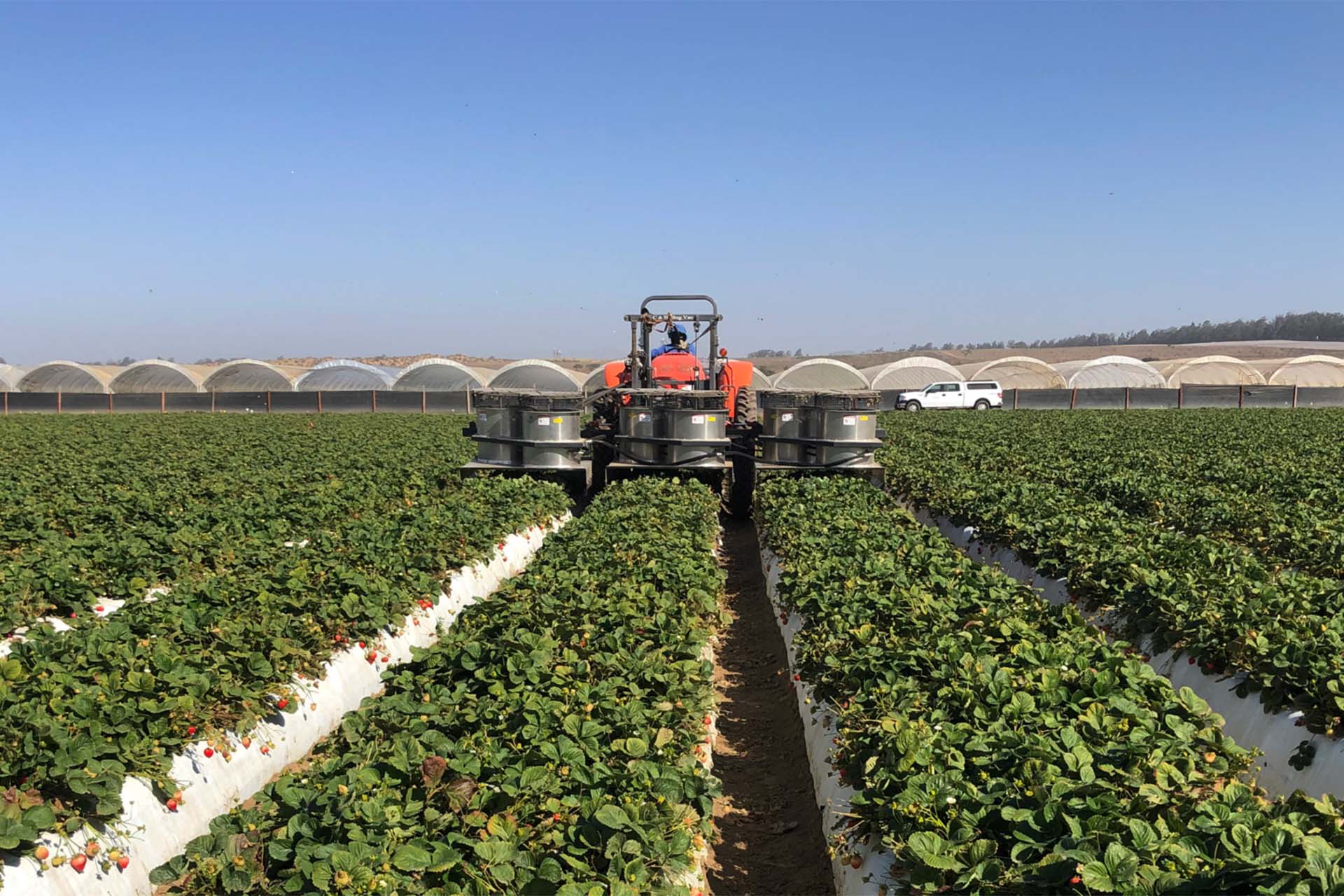
Many strawberry farmers, both organic and conventional, combine strategies to reduce pesticide use, such as beneficial insects and bug vacuums. Learn more in Research, Innovation & Next-Generation Farming.
How are strawberries tested for pesticide residues?
Strawberries are checked by federal and state programs that sample produce close to where people buy it and compare the results with EPA safety limits.1, 3
USDA Pesticide Data Program (PDP). In 2024 USDA sampled in nine states, including California.1 Before testing, samples are washed for 15 to 20 seconds under cold running water, the way a consumer would, then prepared the way people eat them. EPA relies on PDP data for its dietary risk assessments. USDA publishes the results every year.1
California DPR residue monitoring. DPR collects produce year-round from grocery stores, markets, wholesalers, and distributors, and tests it for about 500 pesticides and related compounds. When it finds an illegal residue, DPR traces the produce back to the store, distributor, and farm, and quarantines it.3
EPA safety limits (tolerances). A tolerance is the maximum amount of a pesticide residue allowed to remain on a food. EPA sets a tolerance only after finding a “reasonable certainty of no harm”.4 Federal law requires an additional tenfold safety factor to protect infants and children, unless reliable data show a different factor is safe.12
Who Does What
| Agency | Role | Source |
|---|---|---|
| U.S. EPA | Registers pesticides and sets tolerances (safety limits) | 4, 13 |
| USDA (Pesticide Data Program) | Tests produce nationally and publishes annual results | 1 |
| U.S. FDA | Tests U.S. and imported food for compliance with tolerances | 4 |
| California DPR (part of CalEPA) | Registers pesticides for use in California, tests produce sold in California, and oversees enforcement | 3, 11 |
| County Agricultural Commissioners | Enforce pesticide laws locally and investigate violations on California farms | 2, 11 |
What about PFAS, or “forever chemicals,” on strawberries?
PFAS is a broad label for chemicals that contain fully fluorinated carbon atoms, and which chemicals count as PFAS depends on the definition used.14 People ask about strawberries because some pesticide ingredients contain fluorine and fall under broader PFAS definitions.
EPA’s definition of PFAS requires at least two adjacent fully fluorinated carbon atoms. Broader definitions count any chemical with a single fully fluorinated carbon, which covers more than 15,000 substances.14 EPA says pesticides with a single fluorinated carbon are not PFAS under its definition and “generally lack the persistence and bioaccumulation properties” associated with forever chemicals. EPA holds them to the same safety standard as every other pesticide and has found “no human health risks of concern when approved pesticides are used according to their approved labels”.13 California DPR evaluates each chemical individually, because persistence “can vary widely” among chemicals called PFAS.14
Are strawberries tested for PFAS?
Pesticide ingredients that fall under broader PFAS definitions are included in routine residue testing: DPR says it tests thousands of fruits and vegetables for hundreds of pesticides, “including those that may be categorized as PFAS under broader definitions”.14
What is the Dirty Dozen list, and should it worry me?
The Dirty Dozen is a list published each spring by an advocacy group. It ranks produce by pesticide residues identified in USDA testing, not by the level detected or health risk.
Peer-reviewed research has found that substituting organic for conventionally grown versions of the list’s foods “does not result in any appreciable reduction of consumer risks,” because exposures were already far below safety limits.9 A 2024 study reached a similar conclusion for the 2022 list.10 That’s why health experts encourage shoppers to choose the produce that’s affordable and accessible for their family.
Why are strawberries on the Dirty Dozen list?
USDA tests produce the way people eat it, so fruits, like strawberries, are tested whole, while fruits like oranges are peeled first.1 Strawberry farmers also use precision agriculture, using the minimum amount of specialized products to target specific pests. Therefore, more types of pesticides might be detected, even if the residue amounts are well below established safety limits.
Should I buy organic strawberries to avoid pesticides?
It’s a personal choice. Health experts and scientists agree that both conventionally and organically grown produce is safe and nutritious. More organic strawberries are grown in California than anywhere in the world, and one in four California strawberry farmers grows both. Choose whichever helps your family eat more fruit. Learn more in Sustainable Strawberry Farming Today.
Why are pesticides used on strawberries and other crops?
Farmers use pesticides for the same reason gardeners do: to protect plants from insects, weeds, and diseases that can damage or destroy them. EPA defines a pesticide as any substance meant to prevent, destroy, repel, or reduce a pest.20
Used properly, pesticides help farmers get higher yields and better-quality fruit.23 A scientific review by the Council for Agricultural Science and Technology found that modern fungicides and insecticides “greatly increased fruit and vegetable production”.24 Protecting the crop means more of the fruit that’s grown makes it from the field to your table.
Do organic strawberries have pesticide residues?
Organic farmers use pesticides too. Under USDA organic rules, natural substances are allowed unless specifically prohibited, and certain synthetic substances are allowed when they appear on USDA’s approved list.25 Whether organic or conventional, every pesticide must meet the safety standards described above, and California strawberry farmers use pesticides as one tool among many, alongside field monitoring, beneficial insects, and bug vacuums .
How do California strawberry farmers reduce pesticide use?
California strawberry farmers combine several strategies to reduce pesticide use, on both organic and conventional farms . These include scouting and carefully monitoring fields, releasing beneficial insects that eat pests, planting border crops that attract them, and driving “bug vacuums” through the fields. UV-C light and soil steaming are non-chemical tools being studied, along with stronger, traditionally bred varieties. Strawberry farmers have invested millions of dollars in research, more than any other farm group in the world . Farmers live in the communities where they farm and take extra precautions near schools, homes, and neighborhoods. Learn more in Research, Innovation & Next-Generation Farming.
Do you need to wash pesticides off strawberries?
Rinse strawberries under cool running water just before eating, as you would any fresh produce. FDA advises gently rubbing produce under plain running water and says “there’s no need to use soap or a produce wash”.17 Vinegar isn’t needed to make strawberries safe . USDA’s residue testing is done on produce rinsed the way a consumer would rinse it.1 See How to Wash Strawberries for step-by-step tips.


Sources
- USDA AMS, Pesticide Data Program Annual Summary, Calendar Year 2024 (Dec 2025) —https://www.ams.usda.gov/sites/default/files/media/PDPAnnualSummary.pdf ; press release Jan 6, 2026 — https://www.ams.usda.gov/node/45791
- California DPR, 2023 California Pesticide Residue Monitoring Program Report (July 2025) — https://www.cdpr.ca.gov/report/2023-california-pesticide-residue-monitoring-program-report/ (PDF: https://www.cdpr.ca.gov/wp-content/uploads/2025/07/2023california_pesticide_residue_monitoring_program_report.pdf)
- California DPR press release, “Annual DPR Sampling Report Shows Low Amount of Pesticide Residues…” (July 24, 2025) — https://www.cdpr.ca.gov/2025/07/24/annual-dpr-sampling-report-shows-low-amount-of-pesticide-residues-in-fruits-and-vegetables-sold-in-the-state
- U.S. EPA, “Setting Tolerances for Pesticide Residues in Foods” — read at https://19january2025snapshot.epa.gov/pesticide-tolerances/setting-tolerances-pesticide-residues-foods (live: epa.gov/pesticide-tolerances/setting-tolerances-pesticide-residues-foods)
- USDA AMS, PDP Annual Summary 2023 — https://www.ams.usda.gov/sites/default/files/media/2023PDPAnnualSummary.pdf
- USDA AMS, PDP Annual Summary 2022 — https://ams.prod.usda.gov/sites/default/files/media/2022PDPAnnualSummary.pdf
- USDA AMS, PDP Commodities, Recent (Sept 25, 2026) — https://www.ams.usda.gov/sites/default/files/media/PDPCommoditiesRecent.pdf
- USDA AMS, PDP Commodity History (Sept 25, 2026) — https://www.ams.usda.gov/sites/default/files/media/PDPCommodityHistory.pdf
- Winter, C.K. & Katz, J.M. (2011). “Dietary Exposure to Pesticide Residues from Commodities Alleged to Contain the Highest Contamination Levels.” Journal of Toxicology. https://doi.org/10.1155/2011/589674
- “A screening level human health risk assessment of dietary intake of pesticide residues in produce as compared to consumer guide recommendations.” Critical Reviews in Toxicology (2024). https://doi.org/10.1080/10408444.2024.2316136 (full author list not confirmed)
- California DPR, “About DPR” — https://cdpr.ca.gov/about-dpr
- U.S. EPA (archive), “Highlights of the Food Quality Protection Act of 1996” — https://archive.epa.gov/pesticides/regulating/laws/fqpa/web/html/fqpahigh.html
- U.S. EPA, “Pesticides Containing a Single Fluorinated Carbon” (updated Nov 26, 2025) — https://www.epa.gov/node/298014
- California DPR, “What You Need to Know About PFAS and Pesticides in California” (Mar 20, 2026) — https://www.cdpr.ca.gov/2026/03/20/what-you-need-to-know-about-pfas-and-pesticides-in-california/
- Food Safety Magazine, “EWG Publishes 2026 ‘Dirty Dozen’ List… but is it Scientifically Sound?” — https://www.food-safety.com/articles/11266-ewg-publishes-2026-dirty-dozen-list-of-pesticide-contaminated-producebut-is-it-scientifically-sound
- U.S. FDA, “Analytical Results of Testing Food for PFAS from Environmental Contamination” (Dec 19, 2025) — https://www.fda.gov/food/environmental-contaminants-food/analytical-results-testing-food-pfas-environmental-contamination
- U.S. FDA, “7 Tips for Cleaning Fruits, Vegetables” — https://www.fda.gov/consumers/consumer-updates/7-tips-cleaning-fruits-vegetables
- California Ag Today, residue calculator article (2019) — https://californiaagtoday.com/curious-safe-fresh-produce/ ; Iowa Farm Bureau (June 2017), “181 servings” — https://www.iowafarmbureau.com/Article/Focus-on-eating-more-strawberries-not-whether-theyre-organic
- U.S. EPA, “Assessing Human Health Risk from Pesticides” — read at https://19january2025snapshot.epa.gov/pesticide-science-and-assessing-pesticide-risks/assessing-human-health-risk-pesticides (live: epa.gov/pesticide-science-and-assessing-pesticide-risks/assessing-human-health-risk-pesticides)
- U.S. EPA, “What is a Pesticide?” — read at https://19january2025snapshot.epa.gov/minimum-risk-pesticides/what-pesticide
- UN News, “Climate change fans spread of pests, threatens plants and crops: FAO study” (June 2, 2021) — https://news.un.org/en/story/2021/06/1093202
- UC Statewide IPM Program, Strawberry Year-Round IPM Program: Prebloom — https://ipm.ucanr.edu/agriculture/strawberry/prebloom
- USDA Economic Research Service, Fernandez-Cornejo et al., Pesticide Use in U.S. Agriculture: 21 Selected Crops, 1960–2008, EIB-124 (May 2014) — https://www.ers.usda.gov/webdocs/publications/43854/46736_eib124_summary.pdf
- Council for Agricultural Science and Technology (CAST), The Contributions of Pesticides to Pest Management in Meeting the Global Need for Food Production by 2050, Issue Paper 55 (Nov 2014) — https://www.ag.ndsu.edu/fss/potatoes/CAST_IP55_Contributions_of_Pesticid_4992B5674417F.pdf
- USDA National Organic Program, “Substances for Organic Crop + Livestock Production” (July 2013) — https://www.ams.usda.gov/sites/default/files/media/Allowed-Prohibited%20Substances.pdf